

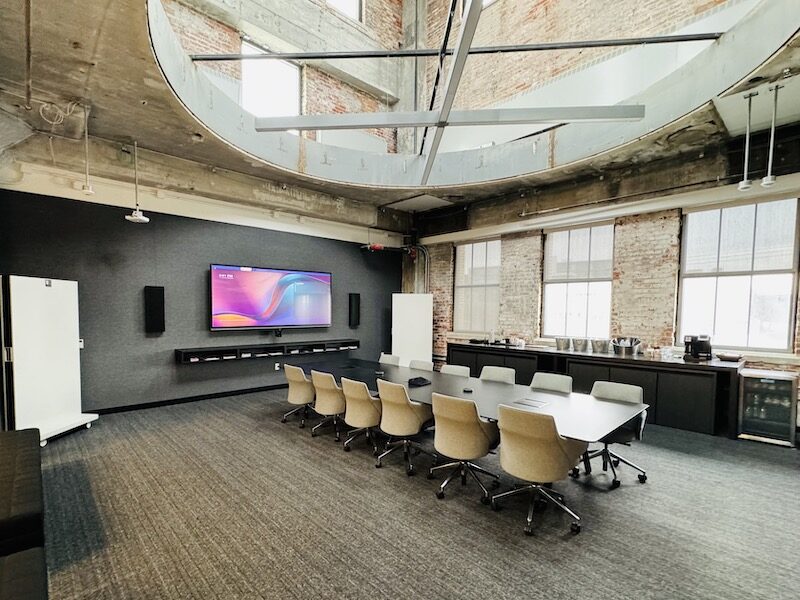
This past year marked some significant advancements in video wall technology, and 2026 promises even more innovation. MicroLEDs are becoming more commercially viable, AI is integrating into systems in a big way, hybrid controllers offer management of multiple sources, energy efficiency is improving, and image quality and display capabilities are better than ever. For businesses wanting to make a statement, there’s never been a better time to invest in a visual display system.
Why Video Walls are So Hot Right Now
Beautiful lobbies and showrooms may impress, but few things grab your attention faster or have the lasting impact of a video wall. It’s the reason they are everywhere these days, from boardrooms and offices to auditoriums, museums, sports arenas, airports, and even fashion shows. Visual displays are becoming defining features of today’s business environments, with a market expected to reach $101 billion by 2033.
Why are they so popular? Video walls are all about creating experiences. Unlike a standard screen or projection, a modular display commands attention with captivating visuals. Ultra-slim designs and high-resolution screens can completely transform a space with bold, immersive, customizable content. Impossible to ignore, they can drive home a business objective, attract an audience, and leave lasting impressions.
MicroLEDs are Leading the Charge
This year, MicroLEDs promise to dominate digital signage markets. This display technology is made of microscopic light-emitting diodes, and each one can produce its own light, color, and brightness, making them self-emissive. This means they can produce extremely bright images, even in direct sunlight, with intense blacks and vivid colors. They offer bezel-free design with truly seamless displays, 100,000-hour lifespans, lower power consumption, and robust construction that lasts.
AI is Changing Video Wall Technology
The foothold artificial intelligence has on technology these days, and the video wall market is no different. AI integration is growing fast, turning simple displays into data-driven, interactive experiences that can be used almost anywhere. Intelligent video walls can analyze data in real-time, such as audience engagement, environmental conditions, or demographic cues, to adjust what is shown on the wall. This means maximum impact for viewers and results in content that is more engaging and timely. AI integration also enhances operational performance and helps make digital signage more efficient and cost-effective. This technology is advancing at warp-speed and will only continue to improve.
Hybrid Video Wall Controllers
Hybrid controllers are more popular than ever thanks to their ability to make complex systems feel simple. They are flexible tools capable of handling live feeds, presentations, streaming video, or dashboards, while keeping everything synchronized and clear. Digital displays are becoming larger and more complex, with more interactive features and higher resolutions that require increased processing power — hybrid controllers can handle that and more. They integrate with cloud or networked platforms, allowing users to customize everything, from displays to resolution, in a single interface. Controlling video walls is simple, user-friendly, and requires no downtime.
The Future for Video Walls
Video walls are becoming smarter, more connected, and easier to manage. Network-based systems and AV-over-IP systems are making displays easier to scale and manage remotely with less need for service. Sustainability is achievable through lower power consumption, longer lifespans, and reduced total cost of ownership, allowing more organizations to invest in one. Interactivity with audiences will continue to increase, making video displays true communication platforms.
Investing in a Video Wall
LED walls steal the show every time with images that make you pause, look, and remember. It’s not just a screen, and it’s no longer a luxury advertising tool — it’s an essential communication and branding asset that blends cutting-edge visual technology with creativity.
While all video walls are designed to influence and attract, look for these features:
- Visual quality: The best video walls offer ultra-high resolution with accurate, bold colors that make images and video crisp and lifelike. Brightness and clarity will look great even in a sunny room or dim lobby.
- Seamless design and options: Invisible bezels between panels create a single, bold image. The best systems allow creative solutions that fit in angled, curved, or uniquely-shaped spaces.
- Ease of use: You should be able to control content and switch between sources with a click, and it should integrate easily with control sources.
- Reliability and low maintenance: Continuous operation that resists overheating and wear is a must. Panels should be easily swapped or serviced, with monitoring options that quickly identify any problems.
- Scalability: Great video walls allow the option to add on or reconfigure.
- Energy efficient: LED technology means reduced power and operating costs.
Ready to get started?
Contact Midwest Audio Visual today and learn more about how a digital wall display can improve your business or organization. We can help you select the best equipment for immersive experiences that last.